
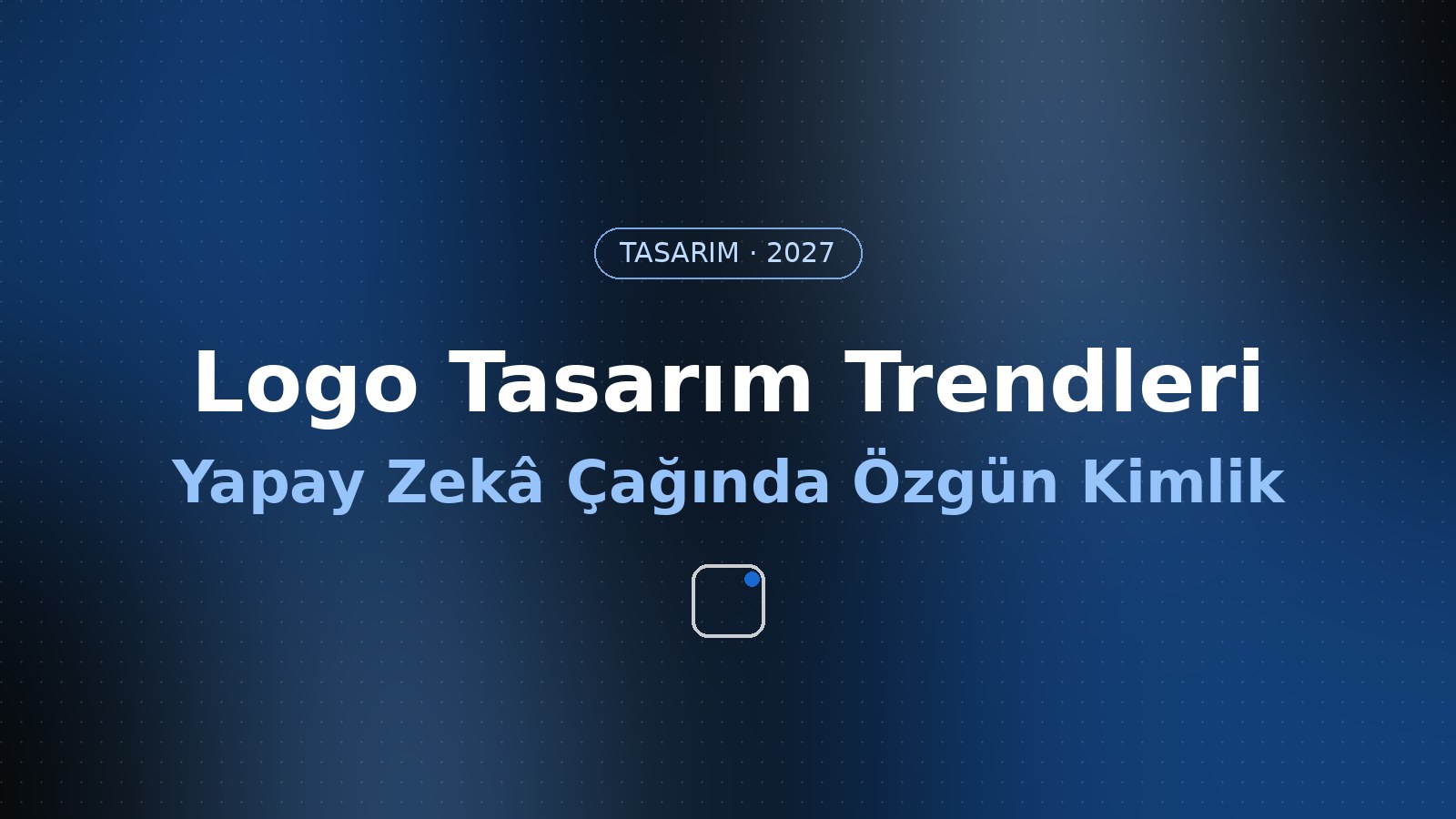
Heading into 2027, logo design trends share one idea: a flawless-looking logo no longer stands out on its own, because AI can generate dozens of "clean" logos in seconds. The brands that get noticed are moving toward "provable" identities, marks whose origin, rules and human decisions can be shown.
One of the clearest summaries of this shift is the 2027 logo trends analysis published by design magazine WE AND THE COLOR on 28 September 2026. Drawing on 2026 rebrands, it argues that documented design systems with a visible decision trail are replacing the single polished file. Below we look at these trends and how brands in Turkey can put them to work.
Why a "perfect" logo is no longer enough
As AI-powered visual tools spread, logos with neat geometry, soft gradients and balanced type have become commonplace. A small business or a new startup can end up with a logo surprisingly similar to one a competitor generated with the same tool. That weakens both memorability and legal protection.
Canva's 2026 design trends report points in a similar direction, highlighting the rise of textured, handmade-feeling, "unpolished" aesthetics. In its survey, 80% of creators said 2026 is the year to reclaim creative control, while 77% see AI as an essential partner. So the point is not to reject AI, but to keep the human touch visible while using it.
Logo design trends gaining ground in 2027
Of the ten trends WE AND THE COLOR lists, these are the most practical for Turkish brands:
- Provenance marks: A hand sketch, a shop sign or a craft process remains visible at the root of the logo. How the logo was made becomes part of the story.
- Range logos: Instead of one fixed file, the deliverable is a set of limits for color, scale and form, so the brand can flex across channels within those rules.
- Voice wordmarks: Custom lettering does not stay in the logo; it grows into the brand's own typeface.
- Archive revivals: Brands bringing older, recognizable assets back to the front. A strong opportunity for long-established Turkish brands.
- One-detail marks: A single surprising element in the logo, with everything else kept simple.
- Native motion: Logos are designed for movement first and stillness second. Given Reels, Shorts and digital screens, that is no surprise.
- Authorship trails: Documenting the human decisions behind a design, which matters more and more because of debates around AI and copyright.
The copyright side: who owns an AI-made logo?
These trends matter beyond aesthetics. In a report published in January 2025, the U.S. Copyright Office stated that writing prompts alone, however detailed, is not enough for authorship. Creatively selecting, arranging or modifying AI output, however, can count as protectable human contribution. On 2 March 2026 the U.S. Supreme Court declined to hear Thaler v. Perlmutter, leaving in place the ruling that AI cannot be an author on its own.
In Turkey, the Law on Intellectual and Artistic Works defines a work as a product "bearing the characteristics of its owner". Legal commentators note that doctrine and case law still tie authorship to creative human contribution. In short, protection for a logo generated entirely by AI sits in a grey area, and consulting an intellectual property lawyer is the safest route.
Practical tips for Turkish brands
If you are starting a new logo or a refresh, these steps will help:
- Document the process. Keep sketches, rejected options and the reasoning behind color and type decisions. It is valuable for your brand story and as a record in any rights dispute.
- Use AI at the ideas stage. AI is very efficient for moodboards, variations and quick exploration. Having a designer shape the final form makes a difference for both originality and protection.
- Ask for a system, not a file. Request a brand guide alongside the logo, covering usage, minimum sizes, color variants and misuse.
- Plan motion from the start. Think about how your logo behaves in a 2–3 second opener while it is still being designed. Social and video content is now a brand's first touchpoint.
- Look at your archive. If your business has been around for years, old packaging, signage or early logos can be a strong source of inspiration. Modernizing something customers already know can work better than starting from scratch.
- Pick one distinctive detail. Logos that try to say everything at once get lost on small screens. One memorable detail is enough.
Conclusion: originality is the new polish
The logo design trends of 2027 are not a backlash against AI; they are an effort to keep human judgment visible while working with it. A brand identity that can tell its origin, has clear rules, is built for motion and has a documented process stands stronger both in customers' minds and legally.
If you want to refresh your brand identity with this approach, or adapt your current logo to digital channels, you can get in touch with Emirhan Koç.
Sources
- WE AND THE COLOR – Logo Design Trends for 2027 (28 September 2026)
- Canva Newsroom – Imperfect by Design: 2026 design trends
- Skadden – Summary of the U.S. Copyright Office report on AI and copyrightability
- Baker Donelson – Supreme Court Denies Certiorari in Thaler v. Perlmutter
- Hukuki Haber – Text Generation in the AI Era: Authorship (Turkish)